Posts categorized “lowend”.

Steven Frank on being a collector

August 25th, 2010

Get down to business.

Steven Frank of Panic on “Collections” with a capital C:

A reasonable goal, it seemed to me, would be to stick to systems and consoles that have deep personal meaning to me; the ones that claimed years of my life: The Atari 2600, the Apple ][ series, and the Amiga. And for spice maybe I’d add a few things that, although I never owned them in their day, were particularly unique or iconic, like the Vectrex.

…I wanted something that I could plug in, tinker with, repair, and show to anyone who wanted to see. A living museum, not a stuffy tomb of priceless artifacts. Real live working interactive history, not skeletons under glass.

The whole piece is great, but it’s this idea, that if you’re a collector, you should actually use the things you’re collecting, that stuck out for me.

I’ve thought about my own collection over the past few months. Newton Poetry hasn’t been the booming place it once was because I either don’t have the time to play with my old Macs like I use to, or I don’t have the inclination. A lot of the old hardware I have sits unused, and that makes me feel guilty.

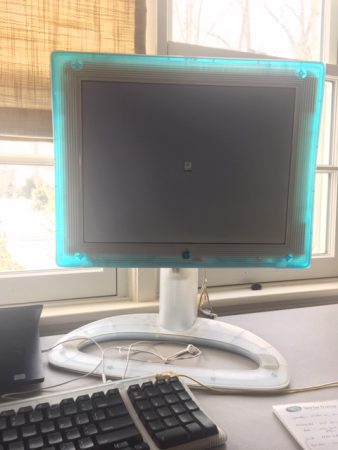
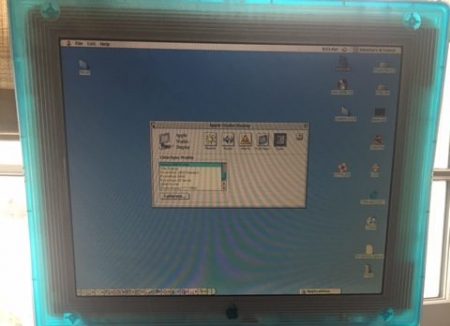
There are a few exceptions. I still turn on my iMac G3 for my budgeting needs (with Quicken 2000) and to play WarCraft II. Lately the Mac SE has become a little journaling/writing station. It’s great to just flip it on, fire up MacWrite, and type away on the ol’ Extended II keyboard. But the PowerMac G4? The LC 520? The iBook G3 clamshell? I haven’t turned them on in months, and so I wonder what the heck they’re good for.

Sometimes I can’t wait to update my VHS collection to DVDs or downloads. Or to buy all my Super Nintendo games on the Wii and never have to worry about cartridges again. But then I think, “When does it all end? When will I never have to upgrade?”

We all face this at a certain point. If you’re reading this, you’re no doubt a collector of something – probably MessagePads or Macs. Maybe upgrading isn’t so much an issue as time and attention and space to dedicate to whatever it is you collect. We have limited amounts of each.

So I’ll keep thinking about it, and maybe reserve my time and space for the Macs and hardware I actually use. I like having a PowerMac G4; they’re neat machines. But maybe it doesn’t have a place in what Steven Frank calls my “living museum.”

Use your tech ’till it hurts

August 4th, 2010

E-waste 2010 -  TVs

Patrick Rhone at Minimal Mac:

That shiny new phone you want you don’t want bad enough yet. That system that is getting “a little slow” is not yet slow enough. Even if it is too slow for you it is more than most of the world could ever dream of having. Seriously, use your technology until it hurts – bad. Because the pain all of this consumption is bringing to a world that is just beyond yours is immeasurable.

Amen, brother. It’s something I’m fond of saying, and often repeat (and practice): just because it’s a few years old doesn’t mean it’s not worth using or tinkering with.

Rhone points to Free Geek, a larger, more organized version of my One Used Mac Per Child brainstorm a few years back.

But there’s a larger issue here than just taking old computers and fixing them up. The materials inside them, when shipped overseas, become hazardous beyond belief. We sit here in modern comfort, tossing out our old cell phones (I once saw a guy throw his phone out his truck window, smashing it on the street) or “recycling” our old Macs, never knowing where they end up.

I do my part, but I’m only one person. I do know many others that care about this stuff, and care about geeking out with old Newtons and Macs and keeping that stuff out of landfills and smelting pots. Kudos to Rhone at Minimal Mac for spreading the word.

The hello Show, episode 11 with Damian Ward

August 1st, 2010

It’s finally here: episode 11 of The hello Show, with David Kendal, me, and special guest Damian Ward.

Damian is a classic Mac collector in the truest sense. We talk about collecting old Macintoshes, why people do such crazy things, and a bit about recent Apple news.

Side note: when it comes to Mario Kart Wii racing, David and I are dead-even. Balloon and coin matches however? That’s another story…

What’s fun is that, with David in Northern England and me here in Michigan, we played a great series of Mario Kart races – even an ocean away.

Syncing Claris Organizer with Newtons – denied!

July 7th, 2010

Through my dragged out Seven Days of System 7 experiment, a few obstacles have blocked a full immersion in mid-90s Mac’ing. First, there was my lost Entrega USB adapter disc. Now I find that Claris Organizer and Newton Connection Utilities (or perhaps my eMate) can only hold hands. They never get past first base.

Dad's contact info

Throwing PIM data into Organizer is a snap. The whole thing is setup just like an Outlook/Entourage/Address Book + iCal system. Even the search works like a charm, and it’s a wonder why Apple didn’t keep Claris Organizer, instead of selling it to Palm, and making a unified PIM system. Maybe it’s the Outlook pro in me, but I prefer it that way.

I built a test account in Organizer, adding a few dates and contacts just to see if it would sync with my Newton. Organizer is a little different in that, once you get your information logged in, you have to save the whole thing as a profile file (in this case, the “davelawrence8″). Everything – contacts, calendars, to-dos – lives in that file. And at first, everything seemed easy and promising.

Organizer / NCU sync settings

Through Newton Connection Utilities, you set the Newton’s sync file to whatever Organizer file you saved as your main profile. To sync, you manually connect each Newton data pool to the appropriate file. In this case, I want everything – my to-dos, my contacts, etc. – to sync with the Newton.

Sync prefs

And for this first time, I set NCU to let the Mac’s information override anything already on my Newton. After the initial sync, I would let it go the other way around, where anything changed on the Newton would be dominant.

No sync for you!

Clicking “Synchronize,” NCU looks like it’s going to sync everything with the Organizer data. And then bonk. There’s a connection error.

Import names

Since I tried to fit the whole PIM bundle the first time, I wondered if it was too much. Instead, I tried syncing the PIM info bucket by bucket. For the first test, I tried just syncing the contacts in Organizer.

Everything goes fine. NCU takes a few seconds to pull down Organizer’s data and push it through the serial connection with my eMate. No problems.

Next, I try the calendar data. And here again, NCU looks likes it’s going to work, and then bam. Another connection error.

Sync repeating appointments

“Maybe it’s my repeating meeting appointment,” I think to myself. So I set my recycling meeting to occur only once instead of a repeating appointment.

PHFFFT. Nothing.

That’s where things stand now. I’ve been defeated. The only thing left to try is to-dos, and maybe do a reverse sync – to see if an appointment added to the eMate manually gets synced with Organizer.

All this is part of the fun of setting up a system for the Seven Days experiment. I haven’t even got a good start on the thing when, POW, some roadblock stands in my way of full integration.

A side benefit: I did come up with a simple Automator Services script (above) that takes PICT files from OS 8/9 and adds the .pct extension to the files in batches. Since I do this quite a bit, making the mundane task a Service was pretty handy.

No Preview for you!

However, as you can see, Preview gives me sass on how to open up these files for viewing. So I said to hell with it and used Photoshop for any editing. But the “add .pct” Service is still a hit.

System 7 update

June 21st, 2010

Funny how one little driver can set your plans back.

Here I was, all ready to begin the week-long experiment using nothing but classic Macs and Newtons, when I discover that I lost my Entrega serial-to-USB dongle’s driver disc. The CD came in a little white envelope and was next to a bunch of other RAM sticks, adapters, Firewire cords, and software CDs. Now it’s gone.

A search through the Internet yielding absolutely squat, and the Newtontalk list didn’t offer any suggestions. The closest I came was one of those sleazy driver sites that makes you wade through stupid ads to get to what you need. When the driver download came up, it still wasn’t what I needed.

Apparently, Entrega was bought out by Xircom, who was in turn bought out by Intel. Intel posts a bunch of downloads for the old Entrega/Xircom adapters, but only an old manual for the one I needed (model U1-D8). The driver is nowhere to be found.

The Entrega adapter was a marvelous piece of technology, helping me to connect to my iMac G3 and becoming my go-to gadget for all things Newton. Even though it’s a USB adapter, it needs a driver to operate correctly. And the usual Keyspan adapters don’t work on my pre-OS X Macs.

My hope in this system 7 experiment was to have my PowerMac G3 run as the hub of the whole operation, syncing my Newton, doing most of the heavy lifting, and connecting with the outside world. It’s true that I could simply connect my Newtons with my iMac G3, but I’d rather have just two Macs running during the experiment: the PowerMac, and the LC 520.

So everything’s on hold for now, until either that Entrega disc shows up (after a fifth or sixth sweep of my apartment) or I give up and go with the iMac for everyday tasks.

Matt’s Macintosh: iMac G4 review

June 17th, 2010

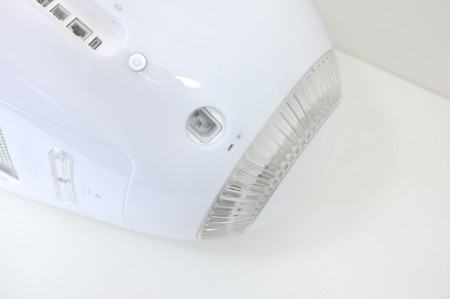
Matt Pearce, the guy behind Matt’s Macintosh, takes a look back at the revolutionary iMac G4 design.

I like that his YouTube videos are both well-made and show an appreciation for all the old Mac and Apple hardware. He’s got a lot of great new and older stuff to show off.

Matt also took my retro Apple.com idea and ran with it, mocking up five designs ranging from the original Apple, complete with the old Newton-under-a-tree icon, to the QuickTake camera.

Vintage Mac Museum

June 14th, 2010

The Grouch

How fun: a site dedicated (more or less) to classic Mac graphics.

The Vintage Mac Museum is in Japanese, but for us English speakers it’s still navigable. The author, Motohiko Narita, posts photos of projects, too, which are a hoot (check out that vertically-aligned monitor for the Mac IIci!).

Lots of fun to poke around, and a great resource for classic Mac graphics.

[Via vintage Daring Fireball.]

Apple’s HTML5 showcase on the Newton

June 8th, 2010

HTML5 Showcase: VR by Splorp

Maybe there’s some chicanery surrounding Apple’s HTML5 showcase being “Safari only,” but Grant Hutchinson has proved one thing – the thing is still usable with the Newton MessagePad 2100′s ancient browsers.

His Flickr set, HTML5 vs. Newton, shows that the HTML5 examples render even on the Newton’s modest Courier and Newt’s Cape browsers.

Says Splorp:

Keep in mind that both browsers were developed prior to the existence of HTML5. While neither piece of software supports the advanced interaction or layout effects afforded by JavaScript and CSS3, the clean HTML5 markup is completely accessible.

That’s called gracefully degraded content.

There are no actual VR demos or typography playgrounds, of course, since the Newton is stuck in mostly a text-only, sliders-free environment. But still. The page they sit on looks just fine, with standard links and formatting.

As Darcy Norman says, web standards ensure a smooth transition from old to new:

Standards, especially ones that support graceful degradation of presentation by devices at runtime, ensure we have access to our content long after it’s built, on devices we didn’t have in mind when we built it.

If Grant were to try to view any of the content I built years ago using Director/Shockwave, or any of 47 terabytes of content built in Flash, the poor little Newton would have barfed violently.

And we don’t want to see any barfing Newtons now, do we?

The day may come when HTML is no longer supported by anything. But then there will always be the classic hobbyists, who ensure that everything gets backed up to something and that there’s a spare Mac around to read those old files.

[Photo courtesy of Splorp at Flickr under the Creative Common License, and link help via Newtontalk on Twitter.]

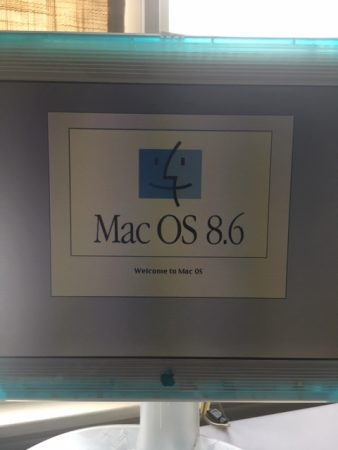
Mac OS 8 doesn’t play nice with iTunes

May 27th, 2010

iTunes vs. Mac OS 8

As I get ready for Seven Days of System 7 (or, more accurately, OS 8), my focus is on loading my PowerMac G3 with software that I might need over the week. Apps like a good, sturdy browser, an image editor, and a music player are all important.

For music, I have a few options – all apps that, as the classic Mac OS period ended, paved the way for iTunes’s dominance. These are apps like SoundJam, iTunes predecessor, and Audion from Panic. I grabbed the final copy of Audion, but wondered if OS 8 could handle an early copy of iTunes.

In a roundabout way, it can. Apparently, the original version 1.0 and 1.1 are both able to run on Mac OS 8.6, with help from a certain patch. Load the patch, install iTunes 1.0 or 1.1, and enjoy the wonderfulness of Apple’s first version of its now-dominant music app.

Except when it comes to legacy software, patches, and theoretically-incompatible operating systems, failure is always an option.

First, the patch. Developed by Loizos Pavlides and last updated in 2001, the patch requires that the iTunes.smi file, the patch installer, and the iTunes installer all reside on the same slab of hard drive space. In my case (and from what I could gather), the best place was the Documents folder.

If you try simply installing iTunes on the Mac’s hard drive, it will proceed as normal. You just won’t be able to open the app.

There it sits on your hard drive, useless and almost foreign with that classic icon. Instead of today’s well-known double eighth note, the iTunes icon used to sport three eighth notes, all different colors.

iTunes patch install

The patch and the two iTunes files now sitting side by side in the spatial Finder, running the patch is a no-frills affair. Pick your copy of iTunes, select everything you want to install (above), and away it goes.

CD Authoring warning

Except that if you pick the “CD Authoring” options, you get this weird warning about incompatibility and USB devices. I had enough trouble finding a USB patch for Mac OS 8, so I opted not to include the CD authoring support. For one, it’s probably the longest non-gibberish warning dialog I’ve ever seen. And two, what a hassle.

If this means I live without iTunes’s CD ripping abilities, I’ll live. There’s always a CD player (so ’90s!) handy.

iTunes for Mac OS 8

After the patch does its thing, you now have another version of iTunes sitting in the iTunes folder, with a “for Mac OS 8″ title. This is the one to use if your Mac is running OS 8, right?

iTunes 1.1 crashing

Wrong. At least in my case. Each time I try to run iTunes for Mac OS 8, it crashes.

The dreaded Error Code 3. Digging into the Classic Mac OS error code database, error 3 means “illegal instruction error,” and running iTunes in Mac OS 8 is definitely illegal. Like, PRAM-zapper-proof illegal.

Though Macwizard says it’s “very common,” the solution isn’t. I came up empty-handed after a bit of digging into the possible solution to the problem. And no matter how many times I reset the PowerMac, iTunes never opens without crashing.

One solution is to simply upgrade the G3 to OS 9, but as I’ve said before, I like the idea of having a Macintosh for every version of the Mac OS.

Reading more of the comments from the patch only added to the confusion – and frustration – seeing that other users were experience hit-or-miss installations of iTunes on OS 8. So for now my attempts to get the thing going are stalled.

Seven days of System 7

May 6th, 2010

Seven Day of System 7

Low end Mac users are masochists. There’s no easy way to take a classic Macintosh and do modern, enjoyable work without some pain or effort involved. Everything is a project.

Now, for most of us that’s not a bad thing. In fact, it’s why we work with classic Macs. Either that, or we know low end Macs so well that using anything prior to OS X comes as second nature. Also, it’s a hobby.

With this in mind, and as I shared on The hello Show this week, I’m undertaking a bit of an experiment: spending an entire week with nothing but my low end Macs. Specifically, I’ll be using:

…as my main computing machines.

I’m leaving my new 21.5″ iMac switched off, using my iPhone 3G for phone calls only, and relying only on Apple products that were released in the 1990s.

I’ll call it Seven Days of System 7.

That’s not totally accurate. I’ll also be using OS 8 (on the PowerMac) and OS 9 (on the iMac). For portability, contact management, and calendar duties, I’ll use my Newton MessagePad 110 and eMate. And I might pull out my iBook G3 and boot into OS 9 for some portable Macintosh.

The experiment, inspired by Morgan Aldridge’s and Riccardo Mori’s experiences, will be me attempting to get by – or even be productive – on non-Mac OS X machines. This includes any writing, web browsing, scheduling, graphic design, and web development. For the week, I’m setting up a special page here at Newton Poetry that will be a sort of proto-blog – where I can post updates through the week. The entire thing will be made on my PowerMac G3 sporting Adobe’s classic HTML editor, PageMill.

Right now, I’m collecting other applications that I might need through the week, including:

  • Claris Organizer for my to-dos, contact management, and calendar, synced to my Newton
  • Corel Graphics 8 for design work
  • PhotoShop LE for image manipulation
  • Panic’s Audion and iTunes 2 for music
  • AppleWorks 6 for spreadsheets or heavy-duty word processing
  • BBEdit Lite for text editing
  • The latest build of Classilla
  • Adobe PageMill for web stuff
  • Panic’s free version of Transmit for FTP’ing
  • A bunch of games for recreation, including SimCity 2000, WarCraft II, and (for the first time) Marathon

Because it’s only a week-long experiment, I won’t need much more than that. I’m not going to do any heavy graphic design lifting, or attempt to do a whole lot. It’ll simply be a week to see how easy it is to be productive and live day-to-day on low end Macs.

There are a bunch of sources I have to credit for the help, including my podcasting pal David Kendal (for the links to Panic’s free offerings), System 7 Today for some game ideas, UNNA for Claris Organizer, and eBay for PageMill and WarCraft II.

The experiment will take place in the next week or two. In the meantime, if you have any ideas or software to try out, let me know.

Most of all, wish me luck.