Posts tagged “ipad”.

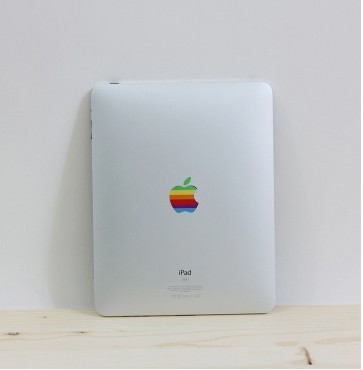
iPod…or iPad?

May 31st, 2010

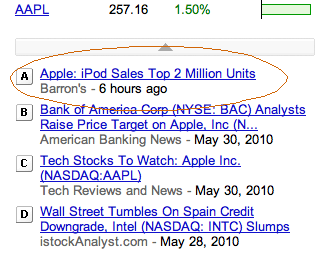
iPods at 2 million?

Weird – they’re just now reaching two million?

Oh wait. It’s a copy-editing mistake (check the URL).

Quote of the week: goodbye, desktop

April 23rd, 2010

“Back in 1998, Apple killed the floppy drive with one fell swoop. Killing the PC desktop won’t be as quick and easy, but Apple will do it over time. It started with the iPhone, and in a few years we won’t even remember the Finder.”

- Sachin’s Posterous, in a very thought-provoking post. I often wonder what OS X+1 will look like. Not OS X 10.7 or 10.8, but after the tens are done. What does the next-generation, non-OS X-based operating system look like?

[Via Sir Kendal.]

Quote of the week: third nipple

April 3rd, 2010

“A signature of Apple’s design philosophy is not to just fire-hose features into a product. They like to believe that if they add something, it contributes way more value than what its presence will cost the user, and that the feature is consistent with the ‘story’ of this product. I’ve seen Android tablets with every kind of port and other hardware feature built-in. Mostly, their purpose is to be something that the marketers and the users can point to and say ‘See? Look what this has that yours doesn’t.’

Sometimes they actually enhance the device. Mostly, though, they’re like a third nipple. Good for conversation, but functionally useless.”

- Andy Ihnatko. Feature lists are great, but they’re not everything. I’m keeping track of some Android fans that say, because the iPad is missing some items, it’s going to be a failure. They tend to concentrate on the wrong thing, like iMac haters did when Apple dumped the floppy disk.

ThinkGeek’s Newton giveaway

April 1st, 2010

Think Geek's Newton prize

So to heck with the iPad – you’ve dreamed of someday winning an Apple Newton MessagePad in some random site’s giveaway.

Well, ThinkGeek has heard your plea. They’re giving away an MP100 and a $1,000 shopping spree from now, April 1, until midnight.

I know, I know – it’s probably a joke, right? Especially considering second prize is an iPad. But Think Geek says, “And while the Newton may seem impossibly awesome, we promise it’s true–this contest is NOT a joke.” Who am I to doubt them? Besides the $1,000 grand prize, the bundled Newton is a heckuva money saver.

When you click through to enter, ThinkGeek asks if you want to receive their updates and promotions, so it could be a genius marketing scheme. Just don’t get me wrong: by “scheme” I mean “I’d love to have one.”

And here I had thought of doing something like this as an anniversary prize or something…
[Via Splorp.]

Epic

April 1st, 2010

The tablet era

March 31st, 2010

Steven Levy’s concise, polished view of the tablet revolution in this month’s Wired (I’m a magazine subscriber) gives a nod to the Newton in one of the “tablets through the ages” sidebar. It was the polite thing to do after talking about Apple’s iPad, the failed Windows Tablet, and the possibility of a Google Chrome OS tablet in the near future.

What’s amazing is that Apple has released some high-tech dopamine in tech pundit’s pleasure zones. Some connection has been made between the iPad, the future of computing, and the hypothalamus – and Levy says the victim will be the graphical user interface we know and (perhaps) love:

One thing we do know is that a heated battle is breaking out over the grave site of the GUI. While unveiling the most heralded Apple product since the iPhone, Jobs presented a powerful and compelling vision of what comes next.

This is the fascinating part of this whole storyline: that now, at the crux of touchscreens and cloud computing and the gee-whiz interface Apple has created, we’ve reached Nirvana.Wired's Newton graphic

Which makes me wonder about other visions of the future, particularly Google’s. After playing around with a few Android devices, I can imagine some powerful tablets featuring Google’s mobile operating system. Forget Chrome OS; Android, to me, offers a much more compelling option if you want to pit the iPad against a true rival.

The open app system, the configurability, the relative polish, the touchscreen interface. It’s all there. For some, the iPad’s computing appliance metaphor is what they’ve always wanted. Less details, less trouble.

But for geeks, an Android-powered tablet is a something to think about.

In any case, it’s nice that the editors at Wired gave the Newton a bit of credit for helping to usher in this Tablet Era – and rightfully so. Rarely is a technology born in the water fully-formed. There are incremental steps along the way. The plow led to the horse-drawn plow led to the John Deere A (that my father, and many farmers, collect) to the modern giant thresher. And just like farmers like to admire and appreciate the classic John Deeres (my dad used to drive one in our town’s Independence Day parade), we can appreciate the quirks and personality of the Newton.

Also, those classic tractors are still useful and running well, with some maintenance. We keep our MessagePads and eMates chugging along as well, even when iPads have passed them by.

Newton ’round the web

March 29th, 2010

The 2010 Bug: Part XXIII: Avi’s solution works for NOS 2.0 (My Apple Newton)
“However extraordinary Eckhart’s feat was in developing his patch for the Newton, it only works for NOS 2.1 machines, leaving NOS 2.0 users seemingly without a solution. Ron Parker confirms that Avi’s solution does fix NOS 2.0 machines (some MP120s and all MP130s) from the 2010 bug. It can be downloaded from here and here. However it won’t fix the bug on NOS 2.1 units.”

Apple renews Newton trademark (Patently Apple)
“When discovering Apple’s latest trademark filings for iBook and iBook Store in the Canadian Intellectual Property Office this week, I also stumbled upon Apple’s filing pertaining to their Newton logo design trademark that appears to have been renewed or has been automatically set to renew on October 13, 2010.”

eMate still a crowd pleaser (Vintage Mac Museum)
“The eMate was not a big commercial success, but may not have been on the market long enough to generate sustainable momentum. In my collection the eMate is a perennial crowd favorite, particularly among kids under 10. Children (and many adults) visiting the Museum always gravitate to this system, intuitively understand how to use it, and comment that it’s a cool little computer. Not bad for a nearly 15 year old device!”

Newton: Best PDA ever (maisonbisson.com)
“Just as I’m about to retire my old Newton, just as I’m exporting the contacts and calendar entries, I rediscovered why the Newton was — and still is — the best PDA ever.”

Apple iPad: We’ve reached Star Trek-nology (ZDNet)
“Since the failure of the Newton, the Tablet or PADD form-factor has always come under intense scrutiny, as no manufacturer or company has been able to make the concept stick.”

Programming for the Newton (McComber Development)
“I’ve been toying with the idea of writing an app for the Newton [...] Of course I’ll want to come up with something that hasn’t been done on the Newton before.”

Behind the iPad: 4 Decades of Clever Technology (Tech News Daily)
“Apple has always stubbornly sought to ‘think different,’ but it decided to think small when it launched its first hand-held device, the Newton Message Pad, in 1993. The Newton created a new category of device — the Personal Digital Assistant (PDA).”

Newton stands with you (Egg Freckles)
“The difference between the Newton and any other modern computer is that the Newton stands with you, the others force you to catch up.”

The Newton, 10 years later

March 25th, 2010

Patrick Rhone at Minimal Mac:

Well, wait until I tell you that I used a Newton MessagePad as my main “daily worker” for years. Every model from the introduction of the MessagePad 120 all the way until the 2100. I used it for web browsing (as it was at the time), reading, email, notes, calendar, address book, word processor, and much more. In other words, exactly as one would use any portable computer. During that time, I saw the sort of computing I was able to do with a handheld device, and the way I was doing it, as the future of computing. With the introduction of the iPad, my faith in that future is regained.

Rhone is springing for an iPad as his main, everyday computing device. Instead of purchasing a new Macbook, he’s keeping his old, black Macbook and “upgrading” to an iPad.

The linked article, the one where Rhone talks about using his Newton MessagePad as an everyday machine, is fascinating:

I used it for everything. I took all my notes with it, used the external keyboard to type up documents and e-mail, managed my schedule and contacts, and, with the introduction of the MessagePad 2000, used it for most of my web browsing. My desktop computers were always simply a backup and data conduit for my Newtons. I did not even own a laptop, my Newton could do all that I needed in a mobile situation.

“All that I needed” is the key quote here, because the iPad (and the Newton before it) represents what most people need: e-mail, writing, viewing photos, browsing the web. For years now, the low-end Mac folks have been saying this same thing as a justification for using classic Macintosh computers. If all you need is e-mail and Word, why not use a PowerBook G3?

But take that idea and make it lovely, fluid, and seamless (and affordable), and you have the iPad. All the stuff I love about Macs – the file system, the tinkering, the more in-depth and specialized software – is what turns most of the people I know away from computers. They don’t want the hassle. They just want to do stuff.

With the Newton, you could have it both ways. Take computing and abstract it: make it a notepad, a calendar, and a few data-tracking apps, and control it with a pen. Or dig into the soup and pry open Toolkit and have your way with the device. The kicker was that this device was too expensive for the simplicity it offered. And hampered by technological limitations of the ’90s.

Simpleness. The Mac shot for it. The Dynabook did, too. The Newton. Magic Cap. The ideal was an affordable, portable, light weight (upkeep-wise), intuitive device that let you get your work done and organize your life.

Rhone felt the Newton was enough in its day, and now feels the iPad is the successor to that simplistic legacy. I think he’s right.

If you’re reading this, the computer – a Mac or PC or Linux box – probably holds a special place in your life. You tinker, you develop, you read up on ways to do things better, or how to fix problems. You work with a screen with a CPU and a keyboard, with an operating system you can change and tweak, with software you can install at will. For me, it’s a hobby. I can’t imagine life without the computer as I know it (in my case, the iMac I’m writing this on).

But for some, like Rhone, the iPad is all they need. For heavy lifting, they can keep a backup.

The Newton used to be the iPad in this equation, as Rhone points out. And for some, the MessagePad will always hold a special place in our hearts. Time and technology, however, have passed the Newton by. If you want to watch movies, browse the almost-full web, play your iTunes content, or even see your pictures in color, and you want the ideal portable computing device, you’re going to have to get an iPad. The Newton can still do a lot of what the iPad can do, and it can still be a useful device. It’s just that the iPad gives you a richer, more modern way to do it.

Rhone calls it a “return to the future” – a sense of some far-off, ideal gadget that fulfills the promises of the early ’80s and ’90s. It’s amazing to think that this flat, touchscreen gadget can, day-to-day, replace a Mac notebook. For me, it couldn’t happen. I wouldn’t want it to happen.

But for some, like Rhone, it’s finally feasible.

Quote of the week: System 5

March 23rd, 2010

“There’s long been grumbling about the iPhone OS’s lack of multitasking capability, especially its suitability as a serious business smartphone. However, the clamor has cranked up by several magnitudes of intensity since the iPad announcement.

My own take is that going back to working without multitasking would be too much like reverting to the early Mac OS – before MultiFinder was introduced for System 5.”

- Charles Moore at Low End Mac, on a neat comparison. He mentions the old Switcher that paused “one running application while you launched another one.” I would think, with the iWork apps on the iPad, you have to have multitasking to get any kind of efficient work done.

Apple TV as odd-product out

March 19th, 2010

Apple TV

The Apple TV has had an interesting history. Starting out, it accompanied the iPhone as Apple’s “next big thing,” even if its spotlight was dim in comparison with the iPhone’s.

From then on, it became a “hobby,” and now I wonder if it’s even that.

Consider this. On the Apple.com Store, the “above the fold” shot looks something like this:

Apple.com store homepage

Notice anything missing? The Macs and iPods and Touch devices are all there in the circle. But no Apple TV. In fact, to find any mention of the Apple TV anywhere on the Store homepage, you have to look under the “For iPod” section:

Apple TV under iPods

Deeper in the store, the Apple TV gets a mention, but under Mac Accessories. So is the Apple TV for iPods or for Macs?

What gives? If Filemaker Pro and Apple’s printer bundle can get a graphical mention on the Store homepage, why not Apple TV?

I put together a current Apple product lineup grid, showing the available desktops, notebooks, touch devices, iPods, and what I call “Misc.” – which just means anything that isn’t any of the above categories:

Current Apple product lineup

The “Misc.” section is a mish-mash. Displays, peripherals, networking and backup products – and the Apple TV. One could argue that it belong with the iPod, but I consider iPods portable music devices. And the Apple TV isn’t quite a Mac, either, even though it runs a version of Front Row and connects with an iTunes library.

No, it’s just kind of out there on it’s own. It has no rock-solid home in the current Apple lineup.

On the other hand, imagine if we added some other category. We’ll call it “Entertainment,” and then add all the other items under “Misc.” as a kind of peripherals-only section:

Hypothetical Apple product lineup

For “Entertainment,” we have to imagine the Apple TV as its own category – perhaps a harbinger to things to come. Of what? There have been rumors of some sort of Apple television. Maybe they’ve been waiting for competition. Maybe they’re striking a deal with Netflix and Boxee right now. Maybe there’s a flatscreen TV out there with an Apple logo on the back, waiting to be released.

It’s just speculation, and I don’t consider it a worthwhile rumor for the time being. Apple, now, seems focused on its Touch devices – specifically the iPad. The Apple TV is surely stuck in some development limbo. One could even argue that the fourth-leg of the Apple stool is now the iPad instead of the Apple TV.

We’re also seeing the Apple product lineup gain some complexity, with the Apple TV fitting in nowhere that makes sense. Remember when Steve Jobs returned, and he cut everything Apple was doing at the time (killing the Newton, say) down to the very minimum? He filled in the final slot in the G3 lineup at the iBook launch in 1999:

Mac G3 lineup

Back then, you had two consumer Macs and two pro Macs. In the G4 era, things became a little less simplified with the PowerMac G4 Cube (unless you want to lump it with the regular PowerMacs) and the iPod. But even then, you could fit products in definite categories: consumer Macs, pro Macs, smaller iPods, and full-sized iPods.

Where does the Apple TV fit in all this? Nowhere neatly that I can figure out. And Apple quarantining the Apple TV from the Store homepage seems to send a message. “If you really want an Apple TV, you’re going to have to dig.”