Posts tagged “sync”.

One Thing Today, DIY style

September 1st, 2010

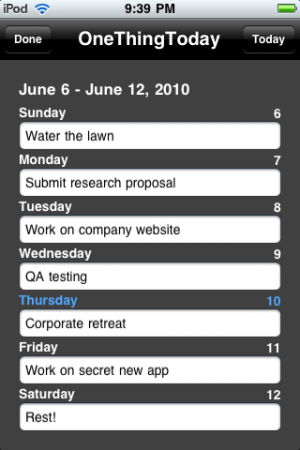
The idea behind One Thing Today (or the Touch version, above) is great: focus on completing one task every day. You get that done, you feel successful.

I’ve operated this way for years. “Tonight I’ll do the dishes, and tomorrow is my writing night, and Thursday I’ve got laundry to do.” As long as I do something productive each night, I don’t feel like a loser.

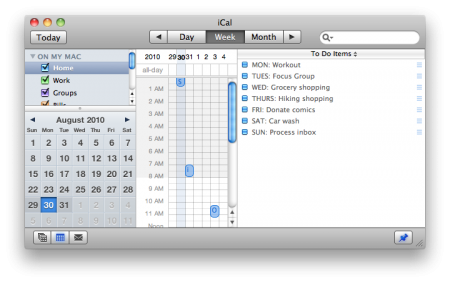
So Line Thirteen does an app for the Mac and an iOS app that puts all that in software form, where each day has some task and only one task. And as much as the app seems worth it for $9 (Mac) or $0.99 (iOS), it seems like you could set up a free version with iCal or a text file. Here’s an iCal version:

iCal One Thing Today

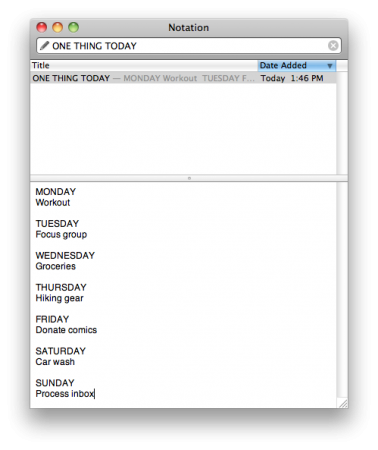
Here’s a text file in Notational Velocity that will sync to Simplenote on my iPhone:

Text version of One Thing Today

If this is the way you think, there’s no reason you can’t make your own system. The benefit of One Thing Today is automatic scheduling and maybe a nicer interface – and I do think it’s neat that someone thinks the way I do and went ahead and made an app.

However, if I can do it myself with the tools at hand – especially sync-ability with NV and SimpleNote – why not give it a try?

Newton Connection Tools helps UNNA

December 14th, 2009

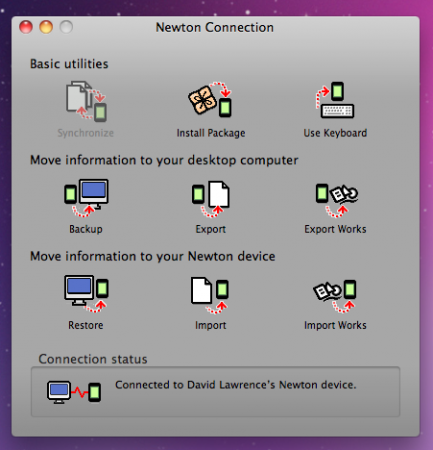
Newton Connection Tools

Andy Galluzzi, developer of Newton Connection Tools for Windows, is now giving the full $45 registration cost of his software to support the United Network of Newton Archives (UNNA).

The Newton Connection Tools license key and the donation to UNNA are intertwined, Galluzzi says on his web site:

The first time you connect, the software will disconnect immediately and you will see the newton information screen. Here you have to export your newton information data (a file nwi will be created) and send me that file . Morgan (administrator of UNNA) gonna tell me who has donated money, and with your newton information data and Morgan confirmation of the donation, I will send you the license code.

A bit complicated, but at least it’s in support of a site we all need and rely on.

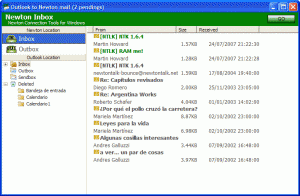
Newton Connection Tools is much like NCX, but for Windows, allowing for Outlook syncs, package installation, and backups. Newton users with Macs have a few options to sync their MessagePads with their computer, everything from Apple’s original Newton Connection to NCX, Escale, and more. Windows users, from what I understand, have fewer options with their Newtons – especially with the newer versions of Windows. There doesn’t seem to be a bit support base, at least developer-wise, on Windows – as opposed to the Mac, where enthusiasts are everywhere.

Taking all that into consideration, Galluzzi’s efforts are even more appreciated.

[Via NewtonTalk mailing list.]

eMate wins low-end writing battle

November 24th, 2009

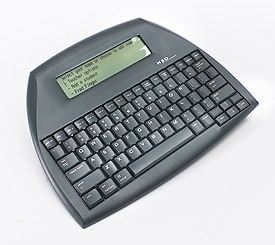
alphasmart

Greg Pak at Pakbuzz was a dedicated AlphaSmart Dana user. It’s portability, small form factor, and battery life made the Dana his go-to writing machine.

But then Pak grabbed a Newton eMate off eBay, for comparison’s sake, and has declared it the “greatest lo-tech writing machine on the planet!” The exclamation point means he’s serious.

In comparing the AlphaSmart Dana, AlphaSmart Neo (above), and the eMate, Pak found they had a lot of similarities:

Both the Dana and the eMate were designed with the educational market in mind. Both are solid state computers with no moving parts and incredibly sturdy plastic bodies. Both run on software originally designed for pocket organizers and feature a stylus rather than a mouse. Both have black and white screens with green backlights. Both use their own barebones but functional word processors that can export and import rtf files. Both turn on instantly and automatically save everything that you type. And both run for days on a full charge.

The difference is in the eMate’s syncing capabilities (thanks to the newest batch of Mac-to-Newton sync software), security, data safety, and geekiness.

The Dana and Neo win in terms of speed, weight, and long-term viability, since they’re still in production.

The fact that the AlphaSmart products both sync with USB out of the box make them attractive. Pak’s issues with document syncing seem like a killer, though. I love the ability to drop a NewtonWorks document onto my Mac desktop as a rich text document and be done with it.

Battery life on both AlphaSmart products, however, seems killer.

Newton connects with Snow Leopard

November 5th, 2009

Newton connects with Snow Leopard

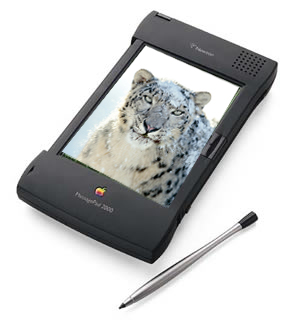
Newton users may wonder, with the release of Mac OS X 10.6 Snow Leopard, whether their MessagePads and eMates would still play nice with the new operating system. You get a new Mac (as I did) with the latest install, and you might worry – is it going to work?

I’m here to report: everything works fine.

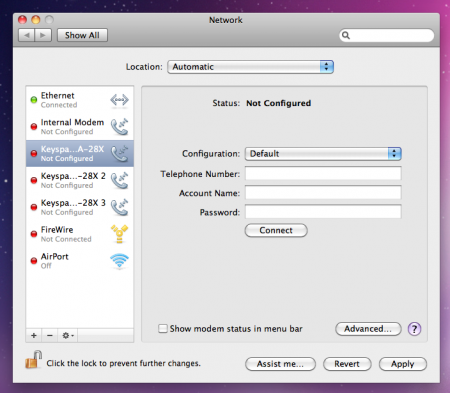
Keyspan USA-28x

I started by download the Keyspan USA-28x driver to my new iMac for the serial-to-USB adapter. Things got weird when Snow Leopard recognized the Keyspan adapter as some sort of dial-up device (above). This wasn’t the case, obviously, but I pressed on just to see if it would work.

Newton Connection (NCX)

I went with Simon Bell’s excellent Newton Connection for Mac OS X (NCX) for the software connection, using a Newton eMate 300.

Since I’m working through the serial connection via USB, I select “serial” in the Newton’s Dock app and – whala. NCX and the Keyspan adapter give me a connection on Snow Leopard.

NCX screenshot function

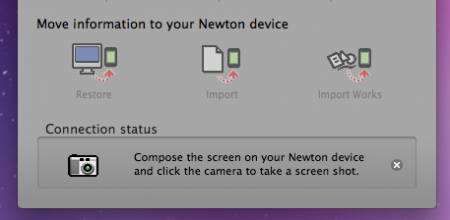
First, I wanted to try the new screen shot function on NCX – something that was only possible before in a few roundabout ways, like with Newton Toolkit.

In NCX, head to File > Screen Shot, then press the little camera (above) and wait a few seconds.

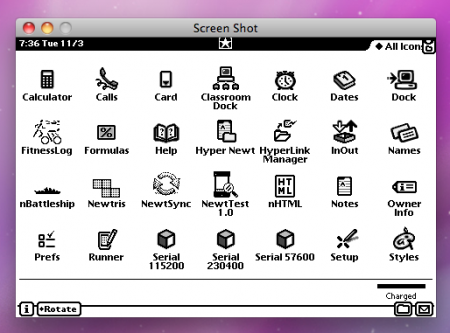
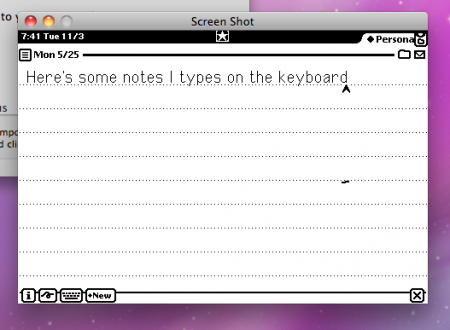
eMate screen shot

And bam, you get a little window pop-up with a screen shot of your Newton. Pretty handy.

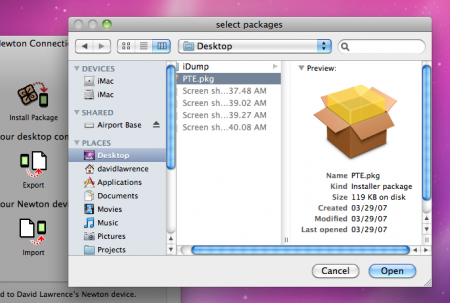
NCX package install

Next, I tried doing what every Newton user does at some point: install a package file. In this case, I picked a periodic table app from UNNA.

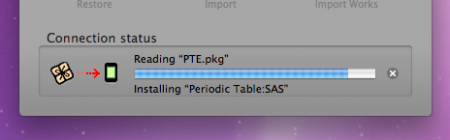
Newton package install

This worked exactly as before.

snowlep_keyboard

So everything, from the screen shots to the keyboard function – which, for me, worked faster than on previous Macs – works great with OS X 10.6.

Trying NewtSync on Snow Leopard

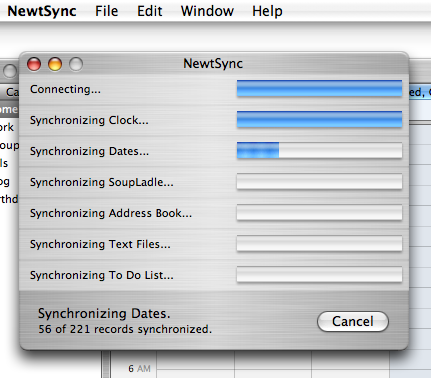
The real test, and the one I’ve had issues with on my eMate since forever, is syncing Address Book and iCal names and dates to the Newton. I’ve had no luck at all so far, besides a few to-do items syncing from iCal to the Newton’s Dates app, and I don’t guess it’ll get much better on Snow Leopard. I tried using NewtSync (above), but had no luck syncing anything.

The important message to take away is that, with software like NCX, it’s possible to connect your Newton, install packages, and do a few other tasks no matter which version of Mac OS X you’re using.

This may not always be the case. There could be some future OS X release that cripples any potential Newton-to-Mac connection. I would think it’d be in the areas of data syncing or unavailable drivers for serial adapters. But the newer MessagePads and eMates allow for Bluetooth compatibility, which shows no sign of going away.

Random error when syncing with NewtSync

November 2nd, 2009

newtsync4

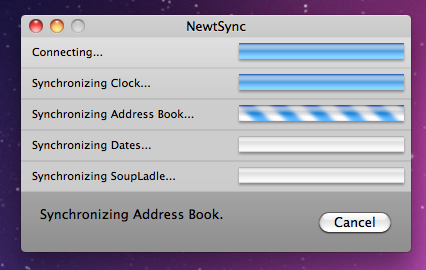
Get this. An attempt to sync my Address Book contacts and my iCal dates with the eMate. I’m using NewtSync with a Serial-to-USB adapter over USB on my iMac G4. And everything’s going fine (above).

newtsync3

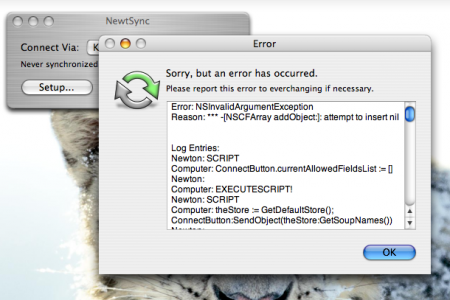
Then this. What gives?

The process never finishes before this error message pops up. My eMate, though, has a lot of the information from iCal loaded from the sync, including repeating appointments. Address Book contact info, however, never makes it over to the eMate.

I’ve had issues syncing my eMate with anything on OS X. Guess I’ll keep trying.

How to do stuff with your Newton

March 26th, 2009

Looking through the Newton Poetry archives, I realize that there are quite a few articles about how to do stuff – fax, connect with OS X, reset – that may have been lost in the shuffle.

Those articles are some of my favorites, because I’m learning how to do them at the same time you are. That’s what I like about writing Newton Poetry: getting my hands dirty with little projects. It’s a blast.

Connect your Newton with Mac OS X
One of the more popular features, this article explains how to use NCX to sync your 2.x Newton with a modern Mac running OS X. You can also learn how to connect with Escale and with NewTen.

Send a fax with your Newton
Faxing with your Newton is old school. The fax seems like an ancient technology, but with a 1.x or 2.x Newton and a simple modem, you can send faxes through the phone line.

Reset your Newton
Let’s say the worst happens, and your Newton somehow locks up or is frozen by a software error. There are different levels of restarting your Newton, and this post explains them all.

Take screenshots on your Newton
Recently, I learned how to take screenshots of my eMate using the Newton Toolkit. There are other, more complicated ways, but this one was the most immediately useful for my needs.

Install packages on your Newton
The Newton is kind of like the iPhone in that you can take it out of the box and it’s immediately useful and usable. But the fun part of owning one is installing cool apps that make it even more useful. That’s where installing .pkg files comes in handy.

Power your Newton with rechargeable batteries
This is more of a tip I learned when using my MP110. Instead of relying on my long-dead Apple battery pack, I bought some Eneloop batteries and used the heck out of them. Soon, I’ll be exploring more energy options with my eMate 300.

Read Newton eBooks
Not only is your Newton a pre-Amazon Kindle eBook reader, but there’s a plugin for Firefox that lets you read Newton eBooks in your web browser.

Why Things for Mac rocks

February 4th, 2009

Shawn Blanc, in his review of the Mac and iPhone versions of Things:

I don’t think the new spins on productivity software are because we have yet to witness the creation of the Ultimate App and Workflow. These unique and diverse apps are being written because people are unique and diverse.

Each of us has our own way of dealing with responsibility and our own expression of productivity. Tinkering and then switching is usually not the fault of the software. We’re not looking the best app, but rather the best app for us.

I use the desktop version of Things, and have since the 0.8 beta version, and I love it. I haven’t purchased the iPhone version yet, however, but plan to in the near future. Of all the things that are most Newton-like about the iPhone, it’s Thing’s sync-ability between the iPhone and Mac apps that most excites me.

Since Apple can’t get off its dead ass and provide iCal to-do syncing, leave it to third parties to fill the gap.

And Shawn is right: I’ve tried a few to-do apps, and none have really caught on. Things caught on, and I think it’s because it gloms onto whatever your style is. Hardcore GTDer? Scatterbrained lightweight? Things is for both of you.

[Via Daring Fireball]

Making the most of my iMac G3

December 29th, 2008

Man vs. Machine

Dan Knight over at Low End Mac posted a great article on how to make a G3 iMac useful. It’s no surprise that I’ve used Dan’s site as a tool ever since I got my own second-hand Bondi Blue iMac, complete with original keyboard and puck mouse, at a recycling e-waste drive.

This happened right after I got my first Mac, my iBook G4, and it gave me a chance to play around with OS 9 and the original Mac interface. It also kick-started my love of classic Macs. The Bondi and I go way back.

Mostly, it’s just nice to look at. The sloping curves, the aqua-green shading, the gum-drop shape – sometimes it’s hard to resist waking it up out of sleep to log on and play around with the OS.

In fact, it’s the one classic Mac I use on a regular basis. At least once a week I fire it up to do several things, both for business and pleasure.

More… »

To MobileMe: thanks for everything

December 9th, 2008

mobilemecancelled

Whew – that was close. Got it done on deadline.

Now it’s official: I’m MobileMe-less.

Why I’ll be canceling my MobileMe trial account

December 4th, 2008

If first impressions are everything, then MobileMe never had a chance.

After I bought my iPhone 3G, I signed up for the trial MobileMe account. Back then, it was only a 60-day free trial, but Apple soon added 30 days onto that, and then 30 days onto that, after MobileMe’s launch arrived like a lead balloon.

The idea seemed swell enough: sync your Address Book, iCal, and Mail settings and entries with the ever-present Cloud, and your iPhone. But since July, I’ve run into more problems than solutions, and MobileMe has been a frustrating mess.

My free trial is up on Monday, Dec. 8. I’m going to cancel my account.

Looking back, I never really needed MobileMe to begin with. trashmobilemeBecause I plug my iPhone into my Mac almost every night, any new entries in either iCal or Address Book get synced each way – from the iPhone to my Mac, and from my Mac to my iPhone. I don’t need the “push” capabilities MobileMe claimed to offer because my syncing schedule was fast enough.

It’s too bad. Apple had a big uphill effort replacing the .Mac service. MobileMe seemed like a decent-enough resolution to everyone’s complaints against .Mac: not much storage, lackluster syncing, no star features that made it seem worth the $99 annual subscription. With it’s modern browser interface and over-the-air syncing, MobileMe looked great on paper. In practice, however, it failed to live up to my expectations.

Maybe it was a lack of habit, but I never found myself missing MobileMe when I wasn’t using it (which was often). If I used my iPhone and Mac for business, the cloud syncing might seem like a bigger deal. But I had a system down, and it worked just fine for me.

The one feature that did catch my eye was the photo sharing galleries. My friend’s wedding photographer put together a beautiful presentation (the subjects helped) using MobileMe’s slideshow capabilities. But again: I don’t really need it. Flickr works just fine as a photo-sharing environment for me. I can make slideshows with Flickr that look fine for my needs. I’m not a wedding photographer. I don’t need anything fancy.

Another thing that bothered me? The fact that iDisk iDisk Sync [thanks commenters!] takes up the 10 GB of space from my hard drive. Maybe I’m a rare case, but when I launch iDisk, it takes away whatever space is available away from my Mac’s “available” space. Why store things on a fragile cloud when my hard drive works just fine? I love the idea behind iDisk, but my iBook is cramped enough without taking that additional 10 GB away.

Apple’s solution? Don’t use iDisk Sync.

The launch didn’t help things. We all remember that, right? The big outage that first weekend. How it took weeks and weeks of Apple tinkering to get even basic services like e-mail up and running for all MobileMe users. For a while there, MobileMe seemed like a big embarrassing misshap for Apple – right up there with the big system outage for the iPhone 3G’s launch. That kind of thing can leave a bad taste in the mouth. I guess it’s never gone away for me.

Part of me is skeptical about this “cloud computing” stuff. I understand that Google seems to have it down, barring Gmail outages, and – lord bless them – Microsoft is working on their own cloud syncing projects. But Google apps like Gmail are hooked up to my Mail.app, which runs from my desktop, and I don’t often make appointments or add contacts through a web browser. That stuff lives on my Mac. I like that I can edit a contact’s information on my iPhone and the change gets logged in Address Book in OS X. There’s no extra log-in-to-the-web-service involved.

If I had several Macs strung out over several locations, with only my iPhone in common, the idea behind MobileMe could come in handy. Backing up my data to the cloud? Sure. Do it all the time. But easy and reliable syncage still seems to be a giant Work In Progress. I’m not yet impressed.

So thanks for the couple of free months, Apple, but I’m saying “no thanks” to MobileMe. Maybe some day I’ll find a use for it – one where I can justify renewing my subscription. Right now, though, I can’t see any good reason to keep MobileMe around. It’s either been a thorn in my side or a non-starter, and life’s too short for either of those.