Posts categorized “ibook”.

Web Pad: iBook G3 as tablet

August 9th, 2010

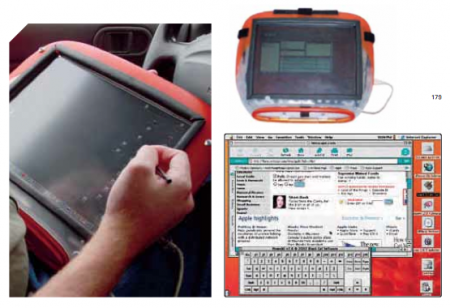
Jeff Paradiso's Web Pad

Before the iPad? The iBook tablet mod.

That was Jeff Paradiso’s idea:

Paradiso, a graphic designer from Boston, took a touch-screen iBook (an after-market modification from Troll Touch), disassembled it, cut a screen-sized hole in its lid, and flipped the screen around so that it faces outwards instead of towards the keyboard. Paradiso changed the desktop icons to large buttons and uses the operating system’s built-in, on-screen keyboard to get around.

After the Web Pad’s construction, Paradiso posted pictures of the iBook’s progress from weird, sturdy notebook to practical tablet.

It’s all a bit like Axiotron’s Modbook idea, except built in true DIY fashion. And it was from several years ago, when an iBook G3 was still a capable web-surfing, video-watching Mac. Today you’d have to do it with a Macbook.

iBook in the attic

October 5th, 2009

iBook G4 in the attic

My first Mac, the iBook G4, in a stylish attic work environment.

[Via Desire to Inspire, via Ffffound!]

On colored eMates and the ‘bMate’

April 15th, 2009

coloredemate

Couple of interesting things I found concerning the Newton eMate 300.

The first: a colored-eMate? From the picture above, it seems Apple (that’s former Apple CEO Gil Amelio and Frank Casanova there) had iMac-like color options slated for this particular Newton model.

Grant Hutchinson did some investigating on the multi-colored eMates, including asking Casanova where the prototypes came from, and turned up quite a few nuggets of good information.

An orange, red, or purple eMate would be a lot of fun to work with (much like my favorite Apple laptop, the clamshell iBook), but I’d love to get my hands on a clear-cased model.

The second concerns the rumored “bMate” – a business-model eMate for on-the-go writing pros. Says Pen Computing Magazine:

Journalists began snapping up eMates as the perfect portable writing tool. Even Steve Jobs liked the eMate. Apple reportedly began developing a “bMate” version for business people, featuring a better screen and a StrongARM processor. Anticipation was high for these new keyboard-equipped Newtons.

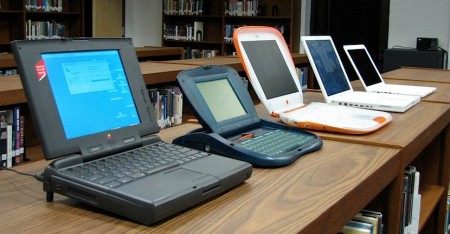
In hindsight, we can now see how the eMate’s design and ideal led to the creation of the original iBook. Salon.com quoted Apple as saying just that:

It’s also possible that Apple will release a version of the eMate based on the Macintosh operating system; the press release announcing the eMate’s demise promises that Apple “will be serving this market with Mac OS-based products beginning in 1999.”

And what do you know, the multi-colored “iMac to go” iBook G3 was released in 1999.

Installing Newton packages with NewTen

December 8th, 2008

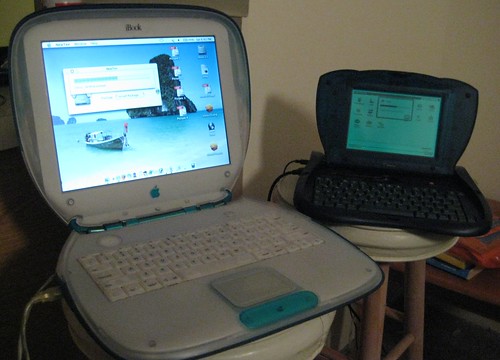
iBook G3 clamshell with Newton eMate 300

Last week I successfully connected my Newton eMate 300 with my iBook G4 running OS X 10.4 Tiger using Escale. This week, my project was attempting to connect the eMate with my iBook G3 blueberry clamshell, running OS X 10.2 Jaguar, using NewTen, another Newton connect app.

More… »

How To: connect a Newton eMate with OS X using Escale

December 1st, 2008

eMate and Escale - we're connected

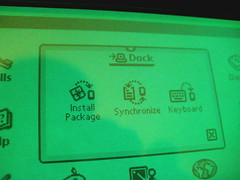
As I hinted at Friday, I had success connecting my Newton eMate 300 with my iBook G4, running OS X 10.4, using a Keyspan serial-to-USB dongle I recently grabbed off eBay. This has been a long time coming. I first wrote about how to connect your Newton with OS X back in March, and there are tons of resources a Google search away, but here – for the first time – I got to see first-hand how the whole process works.

And it’s such a snap.

More… »

Newton eMate gets the (positive) recognition it deserves

November 25th, 2008

best_laptop_block_300

We seem to be in a constant state of list mania in the Newton world, and Mac|Life adds to it with a list of the top five best and worst Apple laptops. For once, a Newton product – the eMate 300 – makes it to a “best-of” list instead of the usual what-were-they-thinking roundup.

Says Mac|Life:

Better known as the PDA That Never Stood a Chance, the eMate was a stripped-down, retooled Newton built exclusively for students and teachers. With a near-30-hour battery; 480×320 resolution, backlit, touch-screen display; serial and IrDA ports; full-sized keyboard; and Newton OS 2.1, all housed in a tough, translucent-blue clamshell case with an $800 price tag, the eMate was a revelation that came at precisely the wrong time — about four months before Steve Jobs regained his position as Supreme Ruler.

Lists like this are conversation-starters, and I’ll take the bait, because I disagree with listing the iBook G3 clamshell as one of the worsts. The magazine pokes fun at the design of the iBook (“equal parts toilet seat, suitcase and clam”), which is purely subjective, while it ignores the clamshell’s functionary details. The same features Apple pioneered with the original iBook – the handle, the ruggedness – were never seen again after the IceBook replaced the clamshell model G3, which perhaps says something.

Some Apple laptops, like the PowerBook 5300 series (hilariously called the “HindenBook” for its ability to spontaneously combust) and the Mac Portable, seem to end up in the scrap heap in every list. Macs like the Twentieth Century Macintosh and the Titanium PowerBook go either way.

Still, it’s nice to see the eMate get some positive recognition for once.

Wired’s iPhone app wishlist includes ‘iNewton’

October 5th, 2008

See here, from this month’s issue of Wired. Looks like my little April Fool’s idea hit the big time:

iNewton: Turns your iPhone into a perfect re-creation of the coolest PDA of 1993.

Coolest PDA ever is more like it.

Now if only someone would take the idea seriously.

Airport Extreme Base Station: something’s rotten in the state of Cupertino

August 3rd, 2008

[Update: I think I found a fix - see here.]

Just when I thought I found a solution to my Airport Extreme Base Station issue, the problem crops up again.

To refresh: after installing the latest base station firmware (7.3.2) and the Airport Utility update (5.3.2), both my n-powered base station connection and my external USB hard drive went haywire. My iBook’s Airport card, nor my iPhone, would not recognize the base station. An Ethernet cord connected to the base station made Internet access possible, but any sort of wireless connection was a no go:

Airport Base Station not found?

Even though my wireless card saw the base station, it wouldn’t connect. Weird, huh?

A few weeks ago, I followed an Apple Support forum poster’s advice by reverting back to the previous firmware, 7.3.1, and reinstalling the Airport Utility fresh from the disc that came with the base station. A fresh start, I hoped, and for a while it worked. Yesterday, though, I noticed my Airport wifi signal dropping out, and my iBook lost the ability to connect to the base station over wifi.

Worse, I lost the ability to connect to my USB drive. As soon as I tried to open up the Airport-connected drive, it signaled a disconnect. The file structure inside was messed up, too: iPhoto crashed immediately after opening as it searched for the drive’s iPhoto library, I couldn’t save files to folders beyond two or three levels deep (see here), and any backups pointing to the drive failed miserably.

Here I had set up a nice system on my new project PowerMac G4, where my iTunes library was synced from the external drive hooked up to the base station. Before, I thought it would be a non-starter because (a) the PowerMac doesn’t have an Airport card, and (b) it didn’t have OS X 10.4 Tiger or the updated Airport Utility. While searching the network, however, the PowerMac spotted the base station and allowed me to connect to the USB drive with a password:

No longer. When I try opening up the drive, it disappear in a cloud of aqua-colored smoke, giving me the above “server connection interrupted” message.

Running Disk Utility showed the drives had some sort of problem, but I’m not smart enough to figure what it means.

And I’m not the only one. Updating to the new firmware and Airport Utility has plagued others, too (in several Apple Support forums), even after the consensus said that reverting back to the previous firmware/utility versions solved the problem. It didn’t solve the problem. The problem came back, for me, after several weeks.

Resetting the base station doesn’t solve it. Unplugging it for a while doesn’t solve it. Resetting my cable modem doesn’t solve it. Disconnecting my USB drive doesn’t help. Even the old revert-back-to-a-previous-version method does nothing. The old strategy was to wait on system updates like this: watch what happens, see what problems erupt, and then download the fix. But who the hell knows when Apple will get a firmware or utility update out? Who would trust it when it is released?

This is a serious issue. Sure, Apple had enough trouble keeping MobileMe up and running, and soothing all the iPhone headaches, but given the choice between a cheap-o Linksys router and an Airport Extreme Base Station, buyers now have a better reason to go with the more affordable option. Who wants problems like these? When I can’t even back up my files without fear of crashing my whole system, Apple’s ease-of-use philosophy is in serious doubt. I can’t imagine what someone with half my patience would do.

It’s hard to put a number on how many base station users are affected by this, but judging from the multiple Apple Support forum discussions addressing this problem, I’d bet it’s no small deal.

Consider this a plea for help. Anyone else having a similar Airport Extreme Base Station issue?

HowTo: Magic Eraser your Mac.

April 28th, 2008

Magic Eraser for my iBook?  You bet.

Owning a two-and-a-half year old iBook is not without its drawbacks. That clean white Apple finish? Totally gross from palm sweat and finger goo.

But I’m here to testify to the power of the Magic Eraser.

It all started when a friend of mine bought a new white MacBook. I brought my iBook G4 over to show her how things have changed. She took one look at my keyboard and said, “Yuck, is that how mine’s going to look?” I said probably, but I was kind of embarrassed. I love Apple’s white, clean look. I didn’t want mine all dirty.

So I bought a sample pack of the Magic Erasers at the dollar store, and gave it a try.

In a word: wow. It’s like a whole new laptop.

I was worried that the Magic Eraser’s intense abrasive action (it works like super-powered, but gentle, sandpaper) might damage the iBook’s finish. But no worries. One swipe and the palm rest looked brand new. And the keys on the keyboard? Gorgeous. A simple application of water, wring the Eraser out completely (don’t want any water sneaking in anywhere), and a paper towel to wipe up the excess. That’s all it takes. It’s like an undo button for your Mac.

Now I just wish I hadn’t waited so long to try it out (others have met similar results). I also wish I had taken some before and after shots, just to show you how nice my iBook looks now.

Next up are the apartment walls and my iPod, whose scroll wheel is looking a little worse for wear.

[Image courtesy Mr. Clean.]

Sunday project: AirPort on a G3 iBook clamshell

March 2nd, 2008

The subject.

[NOTE: I forgot to add this, but I'm running OS X 10.2.8 - just in case the network stuff doesn't look familiar.]

I love my G3 iBook. I bought it right before my Route 66 trip because (a) I was nervous about taking my then-new G4 and (b) the thing is built for road-warriors and students. It’s the toughest laptop I’ve ever seen, and I knew if I took it all the way across the country, it would survive in a pinch.

And it did, both on the Route trip and the Seattle trip. But one drawback was its lack of wireless connectivity. I underestimated the number of hotels – even run-down ones – that have wireless internet these days. One night, in Needles, California, I drove to three different hotels looking for an ethernet connection, never finding one (which is one reason why the Route updates didn’t come as often as I wanted).

Now that’s all over with. I grabbed an AirPort card off eBay for a reasonable price, and took today to actually install the thing. More… »