Posts tagged “serial”.

System 7 update

June 21st, 2010

Funny how one little driver can set your plans back.

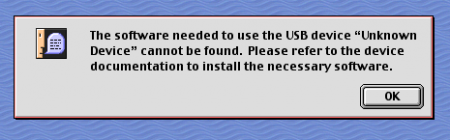
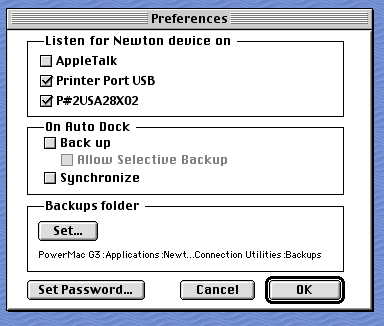
Here I was, all ready to begin the week-long experiment using nothing but classic Macs and Newtons, when I discover that I lost my Entrega serial-to-USB dongle’s driver disc. The CD came in a little white envelope and was next to a bunch of other RAM sticks, adapters, Firewire cords, and software CDs. Now it’s gone.

A search through the Internet yielding absolutely squat, and the Newtontalk list didn’t offer any suggestions. The closest I came was one of those sleazy driver sites that makes you wade through stupid ads to get to what you need. When the driver download came up, it still wasn’t what I needed.

Apparently, Entrega was bought out by Xircom, who was in turn bought out by Intel. Intel posts a bunch of downloads for the old Entrega/Xircom adapters, but only an old manual for the one I needed (model U1-D8). The driver is nowhere to be found.

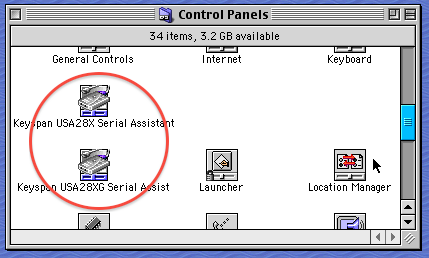
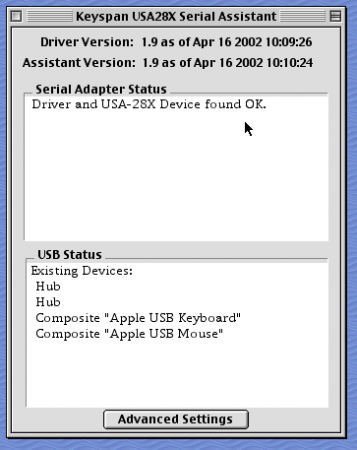
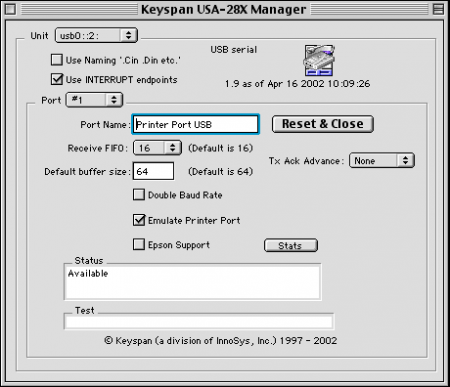
The Entrega adapter was a marvelous piece of technology, helping me to connect to my iMac G3 and becoming my go-to gadget for all things Newton. Even though it’s a USB adapter, it needs a driver to operate correctly. And the usual Keyspan adapters don’t work on my pre-OS X Macs.

My hope in this system 7 experiment was to have my PowerMac G3 run as the hub of the whole operation, syncing my Newton, doing most of the heavy lifting, and connecting with the outside world. It’s true that I could simply connect my Newtons with my iMac G3, but I’d rather have just two Macs running during the experiment: the PowerMac, and the LC 520.

So everything’s on hold for now, until either that Entrega disc shows up (after a fifth or sixth sweep of my apartment) or I give up and go with the iMac for everyday tasks.

Newton keyboard? There’s an app for that

December 1st, 2009

Well I’ll be.

The secret is, you have to have a jailbroken iPhone and a few connectors (details at the namedfork.net source page), but man – look at that thing in action.

Lots of luck to anyone who tries it.

[Via Thomas Brand.]

Using your Newton with Linux

June 24th, 2009

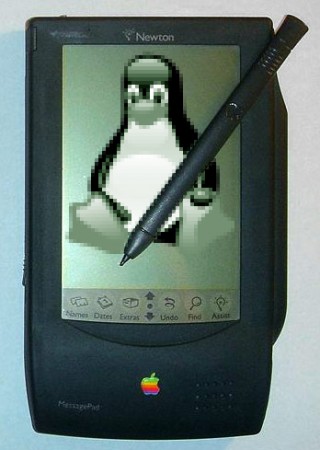
linuxnewton

Here at Newton Poetry, there is One Supreme Operating system, and therefore most posts relate to the Newton interacting with the Mac environment.

I realize, however, that there are other operating systems out there. And, while I’m not a user, I respect that Newton fans can be Windows and Linux users. With Windows, there are tons of tips and how-tos on how to make connections and upload packages and whatnot. Sadly, we don’t hear as much from the Linux side.

Let’s put our operating system differences aside and help Newton users be better Newton users, shall we?

To start, I found the Newton and Linux mini-HOWTO, a site filled with questions and answers (like “How to upload a Newton package to Linux” and “Which Linux software is available”).

Some of the info seems to be dated. For instance, the author talks about Windows-emulating WINE to be a project slated in the future tense. Plus a few of the links are dead. But the basics are all there.

To get connected, there’s Newtonlink.  There are a few more Linux applications for the Newton over at TuxMobil.

Then again, you can always replace Linux on your PDA with the Newton OS. I’m just sayin’.

Any Linux users out there that have successfully paired their Ubuntu with a MessagePad or eMate? Let me know in the comments.

Keyspan adapters page found

January 29th, 2009

[Update 3.8.09: Reader Ivan found an archived page with the correct links. Also check in the comments section for more links.] Keyspan logo

Thanks to a reader, the almost-original Keyspan drivers page has been found.

Torner left a comment on my post about Tripp-Lite purchasing Keyspan. Keyspan makes (err, made) serial-to-USB adapters that us Newton fans use the heck out of, but after they were purchased their drivers download page disappeared.

The new Keyspan drivers page looks just like the old one, but with a new URL, and is much easier to use than Tripp-Lite’s version.

Good sleuthing, torner!

Keyspan bought by Tripp-Lite, drivers relocated

January 26th, 2009

tripplite

[Update: Ivan, in the comments, found the original Keyspan driver page.]

Last week, Leon pointed out that the pages containing Keyspan serial-to-USB adapters were nowhere to be found.

It’s true. Above is the page I landed on when I tried my own hyperlink. The page where Keyspan kept its USA-28x adapter driver was gone.

It turns out that a company called Tripp-Lite purchased Keyspan in May 2008 and dumped all the drivers somewhere else.

Keyspan USB adapters are considered the best in connecting your Newton MessagePad or eMate to Mac OS X. After a quick driver install, you can plug your Newton’s serial cable in one end of the Keyspan adapter, then plug in the adapter into your OS X Mac, and boom – full connection. If Newton users can’t find the Keyspan drivers, they can’t use the adapter.

And the new company, Tripp-Lite, doesn’t make it easy to locate the drivers. There’s a driver search page, and the USA-28x page, but it all takes some sleuthing.

This means that, after several blog posts on how to connect a Newton with an OS X Mac, I’ll have to update the Keyspan driver link. That’s not a big deal.

The big deal is Newton users struggling to find what they’re looking for.

[A big thanks to the Newtontalk gang for helping me locate the new driver pages.]

How To: connect a Newton eMate with OS X using Escale

December 1st, 2008

eMate and Escale - we're connected

As I hinted at Friday, I had success connecting my Newton eMate 300 with my iBook G4, running OS X 10.4, using a Keyspan serial-to-USB dongle I recently grabbed off eBay. This has been a long time coming. I first wrote about how to connect your Newton with OS X back in March, and there are tons of resources a Google search away, but here – for the first time – I got to see first-hand how the whole process works.

And it’s such a snap.

More… »

On order: Keyspan serial-to-USB dongle

November 19th, 2008

keyspanus28x

After an eBay auction went sour and I was awarded a refund, I reminded myself that, from time to time, Newton Poetry covers subjects like…oh, I don’t know…the Newton?

So I took my $30 and lucked out on an affordable Keyspan serial-to-USB adapter – model USA-28x (above). Now we can have some fun with that eMate I picked up, do some connecting with OS X, and play around with NCX, NewtSync, and the rest of the “new” Newton connection utilities.

If you’ve ever wanted to know what those eight little pins in the serial connection do, check out this handy site that lists each pin’s job and function in the Mac system. Pretty cool.

As soon as my Keyspan adapter arrives, I’ll post some project notes on how to connect a Newton with OS X. That is, assuming the entire thing doesn’t explode in my face. But that’s part of the fun, right?

NewtMail: Newton MP130 connects to OS X

September 2nd, 2008

Hello!

I did a search about Newton and I ended up on your great article. I have just bought an old Newton 130 (above) and I was wondering how you have it sync/connect with Mac OS X 10.5.4? I want mine to work with my MacBook and I think I need a USB serial adapter and the serial cable. None of that came with my Newton. Do you have any recommendations? How do you do it? Would be great to hear from you.

Thanks for your time.

Best,
Marcus

Hi Marcus,

Sad to say, I haven’t actually connected my Newton with OS X – I can’t because it’s a MP110, and runs Newton OS 1.3. You need at least OS 2.x to connect.

I found my USB serial adapter (for hooking up with OS 9) on eBay, so that’s the first place to try. A serial cable might be harder to come by, however. Luckily mine came with my Newton, but you could try some online sellers like J&K Sales or, again, eBay. I’m working on getting an updated Newton so I can actually try it out.

…Marcus, who lives in Brazil, wrote back several times to keep me up-to-date on his progress:

Hello Dave,

Thank you for answering! I went ahead and I got 2 serial cables and a Belking USB to serial adapter for Mac (for OS X). I found on Sourceforge that someone wrote a OS X version for this series of adapters, so I HOPE it might work. I don’t intent do get a classic Mac just to sync my 130.

I also found out my backlighting wasn’t working. I saw on eBay someone selling 2 screens for it, new, for $19.95. Already have taken my Newton apart multiple times, but it is scary!

Thanks again for your reply and I liked your blog.

best,
Marcus

Later, Marcus wrote me with more to say on his project:

Hello Dave,

I don’t think I got it to work. I spent all afternoon looking for drivers and trying to hack the existing one. Problem is I did not even find the sourcecode of it on the Sourceforge project page, it’s gone. The F5U003 refuses to run with the Sourceforge driver under 10.5. I think it only works up to 10.3.

I know someone did make it work with Intel and Mac os x 10.3.4 using the driver for the F5U103 (really identical inside), but the hack he did to the kext can not be found anywhere. And since I have Intel and Leopard that solution is out of the question. I just have the instructions, but they are useless without sourcecode.

So now I went ahead and got a Prolific chipset USB to serial adapter, I know they have Mac OS X drivers for Leopard actually that are current on their website. I should have it by end of the week and will give it a new try. Wish me luck! This just might work. If I get it working I will put up something on my own blog. By the way, this is my site and blog. In the meantime my 130 is sitting on my table waiting to talk to my new world MacBook, I still have hopes.

Thank you,

Best,
Marcus

He’s quite the DIYer, isn’t he? Marcus then sent along a final, successful e-mail – with pictures!

Hello Dave,

I have managed to connect my Newton 130 to my MacBook Core 2 Duo via USB! I have attached a few pics of my wiring setup. Works like a charm.

I will probably do a blog entry with nicer photos about this when I have some time. The USB to Serial 232 adapter has a Prolific chip inside, and that driver they are providing for Mac OS X works like a charm. There is a Sourceforge generic driver for all kinds of other adapter brands, but OS X wanted me to remove the generic one and the prolific driver does the job very well. The first software I tried and that works just like the old Apple OS 9 Connection Kit is NCX 1.2. I will try Escale and the others ones as well.

Just thought you liked to know how it is going.

My next venture will be to try and get a WiFi card working in this Newton. :-)

Best,
Marcus

Nice job, Marcus! Here’s a picture of his serial-to-USB setup:

Newton Connection updated to 2.1

April 8th, 2008

Newton Connection, one of the applications that lets you sync your Newton MessagePad to modern OS X Macs, released a 2.1 update that allows for screenshots.

Newton Poetry covered apps like NCX, and it’s nice to know Newton developers are still working hard on viable connection solutions. NCX does everything the old Newton Connection Utilities did, but runs under OS X.

// Via Cult of Mac

Connecting your Newton to OS X

March 10th, 2008

Thursday, Nov. 1, 2007.

One of the challenges of owning and using a Newton in the modern computing world is its lack of support for Apple’s OS X.

There’s no easy direct-connect option that offers the stability and goof-proof usability of Newton Connection Kit or Utilities, but there are options (as this Google Answers commentary points out).

The idea is that, using apps like NewTen, Escale or NewtSync, you can sync your iCal and Address Book entries to Newton’s own Calendar and Names databases. It’s a beautiful idea, and a handy route for us Newton die-hards who want a more modern interface than OS 7+ offers. Who needs a Blackberry or Palm when you’ve got Apple’s original PDA?

I will say that I’ve tried a few these solutions, and none have worked for me. I think that it’s a combination of (a) my USB-to-serial adapter isn’t supported by my iBook G4 and (b) these applications require Newton OS 2.0 to run properly. Stuck at OS 1.3, there’s not much I can do but use Newton Connection Kit on my G3 Bondi iMac.

But some Newton users have used both of these programs with varied success rates. There has been plenty of dicussion in the Newtontalk mailing list about both applications, and some support is out there for Newton users having issues.

So let’s dig into these one by one, and see what each have to offer.

More… »